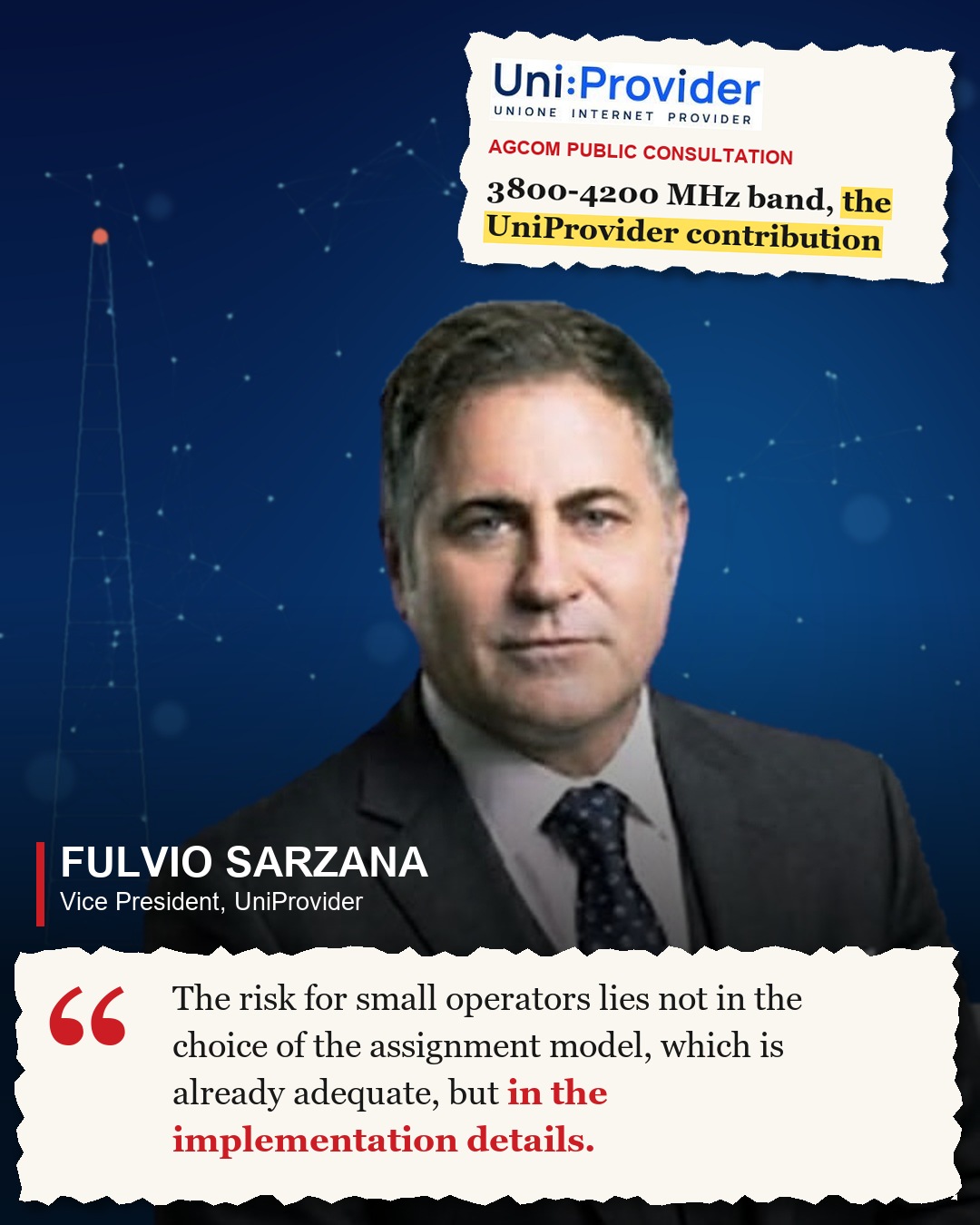
by Fulvio Sarzana di S. Ippolito, Vice President of UniProvider, Attorney, Sarzana & Partners Law Firm
In short. UniProvider, the association of electronic communications operators, has filed its contribution to the public consultation of AGCOM, the Italian communications authority, on the shared use of the 3800-4200 MHz band (Resolution 109/26/CONS). It supports project-by-project, case-by-case assignment, and asks for public, free coexistence data, proportionate requirements for new entrants, and procedures and fees scaled to small operators.
The contribution is among the annexes to the summary of the consultation published by AGCOM on 20 November 2026 (in Italian). UniProvider's document (6 pages, in Italian) answers the consultation questions on the 3800-4200 MHz band under Decision (EU) 2025/2425.
UniProvider, the association of electronic communications operators
UniProvider, Unione Internet Provider, is the association of electronic communications operators, based in Rome. It represents small and medium-sized operators, active at local or regional level, with limited investment capacity, a dense local presence and a last-mile role in areas often left uncovered by the large national players.
It is the reference point for companies in the sector when rules and spectrum are discussed. As Vice President, I follow these files closely. The document carries the names of Dino Bortolotto, Edoardo Potenza (Soluzioni Potenza Srl), Alberto Serraiocco (TELENIA SpA) and mine.
UniProvider's contribution on the 3800-4200 MHz band
UniProvider shares the basic approach of the consultation: assignment project by project, case by case, on a local basis, instead of national tenders or auctions over wide areas. In the document it is the only model that, without a national auction or tender, leaves real room for small operators: an economic competition would reward only those who can bear high participation costs.
The observations indicate where the model needs to be refined, so that access to the 3800-4200 MHz band does not end up concentrated in the hands of those with greater technical and legal resources. The document sums it up: the risk for small operators lies not in the choice of the assignment model, which is already adequate, but in the implementation details.
Coexistence data and mitigation measures
Checking coexistence with the systems already present in the band and the adjacent ones requires data that today is not public in a form a small operator can use. An operator with a single radio-frequency technician cannot afford months of informal requests to the Ministry to find out whether an area is free.
UniProvider asks that the ministerial portal publish, before applications open, a searchable map of the exclusion and coordination areas around sensitive installations and the Matera station, showing the 3815-3875 MHz and 4105-4195 MHz portions reserved for Defence. The data must be free and accessible without institutional credentials.
Coexistence measures should rely on case-by-case coordination, exclusion areas, power and technical configuration limits, synchronization or other mitigations, and a compatibility check of the project before the right of use is granted.
Requirements for new entrants and assignment to operators
On technology, UniProvider asks for neutrality: no privileged standard, and attention to the use case of small local operators, namely low-power fixed wireless access (FWA) in rural or peripheral areas where fiber does not reach and public 5G in the 3400-3800 MHz band does not guarantee sufficient capacity. The operators in the association report interest in low-power profiles on circular areas of 50 metres, with blocks of 20-40 MHz per site.
The association supports opening assignment to companies not traditionally network operators, provided requirements are proportionate and verifiable. It asks, however, that the model also be extended to ISPs, WISPs and authorized operators. For the technical capacity criterion it proposes accepting a support contract with a qualified third party, and that the Ministry publishes the minimum subjective requirements before the portal opens, with a dedicated consultation period.
Procedures, costs and reporting
- No rigid limit on the number of areas or installations per project: an operator covering several towns in the same province should be able to file a single project.
- Structured compatibility checks: before rejecting an application, the Ministry should indicate a set of alternative compatible parameters.
- A simple application, with only the essential parameters, and an automated portal with a pre-check, so that a first attempt in the queue is not wasted.
- A tempered first-come, first-served rule: in the first six months, collection windows with non-sequential assessment, for example fortnightly.
- Administrative fees calibrated on simple cases, and spectrum fees with a reduction coefficient for at least 24 months for operators below a turnover threshold (in the document, for example, 10 million euros).
- An annual report limited to essential data, in a simple format.
On the minimum block of 20 MHz, the duration of rights from 3 to 10 years and the ban on leasing frequencies, with transfer allowed on a sale of the business, UniProvider has no objections. The association remains available for a hearing on the requirements for new entrants and on fees for small operators.
On spectrum, see also the firm's piece on the 26 GHz tender notice (in Italian).
Frequently asked questions on the 3800-4200 MHz band
UniProvider, Unione Internet Provider, is the association of electronic communications operators, based in Rome. It represents small and medium-sized operators, active at local or regional level, and is a reference point for companies in the sector on rules and spectrum.
It supported project-by-project, case-by-case assignment and asked for public, free coexistence data, proportionate requirements for new entrants, simple procedures and fees scaled to small operators.
It is the public consultation launched with Resolution 109/26/CONS on the shared use of the 3800-4200 MHz band by medium-low power terrestrial wireless broadband systems, under Decision (EU) 2025/2425. AGCOM published the summary on 20 November 2026, with the contributions attached.
Because checking coexistence with systems already present requires data that is not public in a usable form. UniProvider asks for a searchable map, free and without institutional credentials, of exclusion and coordination areas, before applications open.
The operators in UniProvider report interest in low-power profiles on circular areas of 50 metres, with blocks of 20-40 MHz per site, for FWA connectivity in rural and peripheral areas. The 20 MHz minimum block proposed by AGCOM looks adequate.
An application with only the essential parameters, an automated portal with a pre-check, an initial phase without strictly sequential assessment, administrative fees calibrated on simple cases, a reduction coefficient on spectrum fees for at least 24 months for operators below a turnover threshold, and an annual report limited to essential data.
 English
 Italian